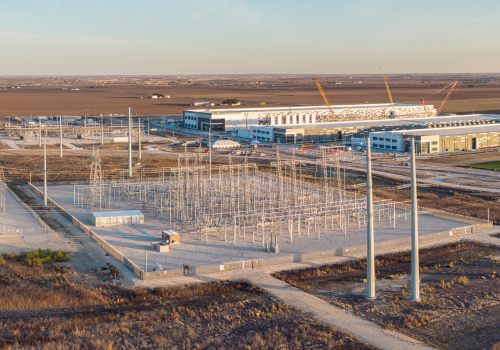
A data center construction boom is well underway as the use of AI technology accelerates. States have seen a surge in interest and investment from hyperscale data center developers and colocation providers—companies that lease space, power, cooling, and network connectivity.
An August 2026 analysis from McKinsey & Company shows that by 2030, companies will invest almost $7 trillion in capital expenditures on data center infrastructure globally. More than $3 trillion of that investment will go toward areas such as real estate and power infrastructure. Forty percent of this spending is expected to occur in the United States. According to the Associated Builders and Contractors, through April 2026, spending on data centers rose to a seasonally adjusted annual rate of $50.7 billion in 2026, up 28.1% from the previous year.
The Race for Water and Power
As construction accelerates, the amount of water and power required by data centers is raising concerns among utilities, government agencies, and consumers. In the United States, data centers accounted for approximately 4.4% of annual energy usage in 2023, consuming 176 terawatt-hours (TWh). Some projections indicate that data center energy consumption could double by 2028.
An AWWA report, Cooling the Cloud: Water Utilities in a Data-Driven World, states that while water consumption by data centers currently represents a relatively small share of total U.S. water use, it is growing rapidly. A 2021 report estimated that U.S. data centers consume 449 million gallons of water per day, or 163.7 billion gallons annually. Some large hyperscale facilities can consume up to 5 million gallons of water per day.
“The challenge is that AI-driven data center demand is outpacing traditional utility planning cycles,” says Bill Tesarek, CEO of Alsay Inc., a Texas-based water infrastructure company specializing in groundwater and water supply solutions for municipal, industrial, commercial, and agricultural clients.
“Data centers could be similar to other industrial customers—requiring only planning, foresight, and some distribution and transmission system upgrades—or they could be considerably disruptive if their demand profile is so large or variable that it risks exceeding important thresholds, such as treatment capacity or available water rights,” says Adam Carpenter, Senior Manager of Environmental Policy for AWWA.
At ComEd, Illinois’ largest electric utility, demand is expected to double by 2040 if all projects currently in the development pipeline come to fruition and reach their maximum projected load. This estimate was cited by Max Leichtman, Director of Economic and Workforce Development, during an Illinois House Executive Committee meeting in April 2026.
As the race to build AI capacity accelerates, some data center developers have begun taking power generation into their own hands. Rather than waiting for utility connections, they are developing privately owned generation campuses to serve hyperscale facilities, such as Pacifico Energy’s GW Ranch Project.
Similarly, Google has partnered with virtual power plant (VPP) operator Voltus in a three-year agreement to create a network of distributed energy resources, including smart thermostats and batteries, to help manage electricity demand during peak periods. The initiative could provide up to 100 megawatts of capacity annually across the PJM Interconnection region.
Meeting Growing Water Needs Requires Communication and Planning
“If you've met one data center, you've met one data center,” says Mark Peterson, Deputy General Manager of Administration, for Loudoun Water, a water utility located in what is known as the “data center capital of the world,” Ashburn, Virginia. “They're all different.”
One major factor affecting water use is the cooling technology deployed. Air-cooled systems generally require more energy, while water-cooled systems consume more water. Some facilities are able to use recycled or non-potable water for cooling, reducing demand on drinking water supplies.
Loudoun Water built a reclaimed-water network before the current data center construction boom, allowing facilities in the area to take advantage of alternative water sources.
“If you include reclaimed water as part of our supply portfolio, along with drinking water used for cooling, data centers account for about 12% to 13% of total water use,” says Peterson. “That number is manageable for us.”
According to Peterson, data center growth has remained manageable through long-term planning. They rely on wholesale agreements for drinking water from Fairfax Water and sewer service from DC Water and operate their own water reclamation and drinking water facilities. A new quarry storage facility will provide additional emergency supply and system resilience.
“We continue to follow a planning process and expand our facilities to support growth throughout our service area.”
Other utilities may face challenges related to capacity constraints, accelerated planning requirements, and compressed development timelines.
“Historically, it would take years for demand to grow by the equivalent of 3,000 to 16,000 homes,” says Tesarek. “Today, a data center can be built in a fraction of that time.”
At San Antonio Water System, Donovan Burton, Senior Vice President of Water Resources and Governmental Relations, must anticipate the impact of adding another 10 to 12 hyperscale AI data centers to the 25 traditional data centers already operating in the region.
“Planning is difficult,” says Burton. “We don’t know how many projects will actually come to fruition.”
The utility holds planning meetings to determine each facility’s water requirements and encourages developers to use recycled water wherever possible. Burton remains confident that the utility can meet future demand with the help of its recycled-water system, one of the largest in the nation, spanning 130 miles.
The type of power supply selected can also affect water demand.
According to Burton, some facilities are considering microgrids or smaller scale power plants dedicated to data center use while awaiting permanent grid connections. Complicating matters further is the fact that municipalities often maintain different water management policies while drawing from the same regional water resources.
“More data centers popping up in the region can put pressure on shared water supplies,” Burton says.
“Improvements to the water system will be needed,” he adds, “but they will take time.”
Carpenter agrees.
“There’s the need to create designs, evaluate existing conditions, complete permitting, and then build the infrastructure,” he says. “Depending on the scope of the project, that process can take months or even years. That’s why it’s so important for water utilities to be involved early whenever large water users are being considered.”
How Water Needs Translate into Investment
San Antonio Water System’s five-year capital plan calls for more than $3.2 billion in investment.
“We need more contractors to do the work,” says Burton. He encourages contractors to register with the utility to receive notifications about upcoming projects.
“In many Texas markets, utilities and municipalities are recognizing that existing infrastructure was not designed for this level of growth,” says Tesarek. “As a result, we're seeing more projects move from planning to execution, with a focus on long-term resilience and capacity expansion.”
Tesarek expects increasing demand for groundwater development, well drilling, rehabilitation projects, pump systems, transmission infrastructure, and long-term water supply solutions.
Grid Connection Delays Are a Challenge to Data Center Development
Grid interconnection delays have become one of the greatest impediments to deploying new energy generation and data center capacity in the United States.
According to ENKI, a commercial intelligence platform for emerging technologies, the queue for connecting new resources to the grid has grown to 2,600 gigawatts (GW), while the median time to commercial operation is approaching five years.
At an event hosted by the American Enterprise Institute, Marsden Hanna, Global Head of Sustainability and Climate Policy at Google, cited transmission constraints as the No. 1 challenge facing grid expansion efforts. In some cases, developers face delays of up to 12 years before obtaining power for new facilities.
To ensure customers receive safe and reliable service, electric utilities such as ComEd require accurate and up-to-date projections of power demand from proposed data centers.
“In addition, since demand projections play a role in the purchase price of wholesale electricity supply, the PJM capacity auction is seeing increased prices due to a forecasted supply-demand imbalance,” says Thomas Francis, a spokesperson for ComEd.
Mandated queue reforms, including the Federal Energy Regulatory Commission’s transition to a “first-ready, first-served” cluster-study process, along with regulatory efforts to evaluate grid-enhancing technologies and the deployment of AI-powered study software, are intended to help accelerate grid connections.
ComEd is expanding transmission infrastructure and reinforcing its distribution network by building new substations and expanding existing ones. The utility is also addressing transmission constraints in areas where demand is already high or expected to increase.
“We’re investing in advanced transmission technologies that unlock additional capacity on existing wires,” says Francis. “We’re also taking steps to ensure more distributed energy resources—including rooftop solar, community solar, and battery storage—can connect to the grid.”
In addition, more grid-scale generation resources are expected to be needed in northern Illinois and throughout the broader 13-state PJM transmission network.
Costs to Expand the Grid
Capital expenditures are growing dramatically among U.S. utilities and technology companies.
Deloitte Insights forecasts combined capital expenditures approaching $1 trillion by 2032, including approximately $432 billion from utilities and $525 billion from hyperscale data center operators.
ComEd’s four-year distribution grid plan for 2028–2031, currently under review by the Illinois Commerce Commission, proposes approximately $15 billion in investment, up from $12.3 billion during the 2024–2027 period.
New safeguards are intended to ensure that large grid customers pay their fair share of infrastructure costs. For example, Transmission Security Agreements (TSAs), introduced in 2025, require new customers with loads of 50 megawatts or more to make firm financial commitments backed by credit guarantees early in the engineering process. In addition, regulatory changes approved by the Illinois Commerce Commission now require large power project developers to provide higher upfront deposits when applying for new electric service.
The Water-Power Connection 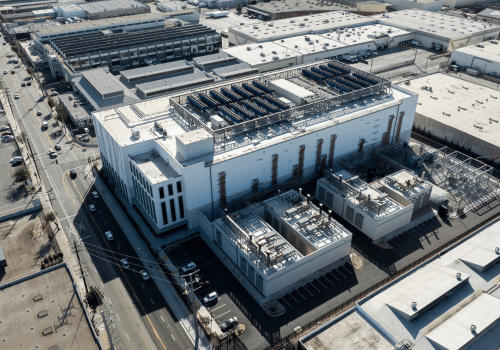
“Water and power infrastructure are deeply interconnected,” says Tesarek.
Power is required to operate servers, which generate significant amounts of heat. Water is often needed to cool those servers and, in many cases, to generate the electricity that powers them.
As data center development accelerates, both energy and water utilities will face growing pressure to expand their systems. For contractors, that challenge represents a significant opportunity. Investments in water supply, transmission infrastructure, substations, generation assets, and grid modernization are expected to drive one of the largest infrastructure buildout cycles in decades.
Download the 2026 Utility Outlook
Learn how surging demand is creating unprecedented opportunities for utility contractors.
Key takeaways:
- The U.S. is launching its largest power infrastructure buildout in generations, creating major opportunities.
- Clean energy growth is driving massive construction and grid modernization investment.
- Jobs are concentrated in fast‑growing regions, with specialized skills earning top pay.
Subscribe to The Utility Expo monthly newsletter to receive more industry insights like this.
Read Next
How the $174B Grid Rebuild is Creating a Jobs Super-Cycle for Utility Contractors in the AI Era
Why Rural America Needs Fiber Broadband
The Future of Drones in Utility Infrastructure Maintenance