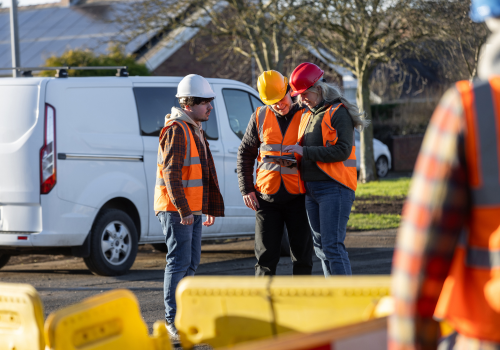
Technical skill may earn someone the opportunity to lead a utility crew. It does not automatically prepare that person to set expectations, handle conflict or make decisions for an entire team.
Leadership influences far more than morale. Gallup found that managers account for 70% of the variance in team engagement, a factor linked to productivity, work quality and safety.
On a utility jobsite, those outcomes show up in very practical ways. The crew leader’s decisions influence whether information reaches the field, workers speak up about changing conditions and technology supports the work instead of complicating it.
These four practices help utility crew leaders turn their field experience into effective leadership.
1. Set the Standard Before Problems Arise
Many leadership issues begin as expectation issues.
Crews figure out quickly what matters to the person in charge. They watch what gets corrected, what gets ignored and how the crew leader responds when production falls behind. If shortcuts are tolerated when the schedule tightens, the crew notices. If safety suddenly becomes important when someone from the office visits, they notice that too.
The best crew leaders establish expectations early. Everyone should understand what quality work looks like, how concerns should be raised and what level of accountability comes with the job. Waiting until something goes wrong leaves the crew to develop its own standards in the meantime.
Inconsistent expectations eventually produce inconsistent work. One crew follows the process while another creates its own version. Quality and safety begin to depend on who happens to be running the job that day.
Consistency does not require handling every situation the same way. Conditions change and people require different levels of direction. The standard, however, should not move with the weather, the deadline or the mood of the person leading the crew.
2. Make Communication Useful
Every utility contractor has seen some version of the same problem. A revised plan never reaches the field. A condition changes onsite but never makes it back to the project manager. The office assumes the crew has the latest information while the crew assumes the office understands what is happening on the jobsite.
Bridging that gap falls to the crew leader.
That position requires more than passing messages back and forth. Crew leaders have to clarify expectations, surface issues early and speak up when field conditions no longer match the original plan.
Communication failures rarely show up as communication problems. They appear as rework, delays, damaged utilities, frustrated customers and safety incidents. By the time those consequences are visible, the real problem often happened days earlier when critical information failed to reach the right person.
Toolbox talks can help, but only if they create a conversation. Asking "Any concerns?" often leads to silence. Asking what changed since yesterday, where the plan could break down or what the newest person on the crew needs to understand usually produces a different response.
Just as important, workers need to know they can raise a concern without being brushed aside. The quickest way to shut down communication is to make people regret speaking up. Strong crew leaders create an environment where questions, concerns and observations are treated as part of getting the job done right.
3. Make Safety Part of the Job
Safety is not just the responsibility of a safety department. The Center for Construction Research and Training (CPWR) identifies supervisory leadership, employee involvement, communication and accountability as leading indicators of a strong jobsite safety climate. The findings reinforce a reality many contractors already know: crews take their safety cues from the people leading them.
That influence starts before work begins. Depending on the task, a utility project may require a competent person, a qualified electrical worker, an attendant, a confined-space observer, a qualified rigger or a certified operator. Crew leaders should know which roles are required, who is qualified to fill them and who has the authority to stop work when conditions change.
Those responsibilities should never be figured out on the fly. Everyone on the crew should understand who is responsible for what before work starts. When accountability is unclear, important decisions can be delayed, hazards can be missed and workers may assume someone else is addressing the problem.
The consequences are especially clear in excavation work. OSHA reported 39 trench-related worker deaths in 2022. That number fell to 15 in 2023 and 12 in 2024 following education, outreach and stronger enforcement, including a zero-tolerance policy for unprotected trenches. The decline shows what focused action can accomplish, but 12 deaths still represent 12 preventable losses.
Assigning safety responsibilities is only the beginning. Ground conditions shift. Weather changes. Equipment moves. A plan that made sense during the morning briefing may no longer match the conditions by the afternoon. Strong crew leaders keep evaluating conditions and make it clear that production goals never override changing jobsite realities.
4. Use Technology Without Losing the Crew
A dashboard can show that a project is on track. A five-minute conversation with the crew may reveal otherwise.
New technology can improve a project, but it can also create confusion when crews are asked to change how they've always worked. Digital plans, utility mapping, machine control systems and real-time jobsite data can help teams coordinate work, avoid conflicts and make faster decisions. The challenge for crew leaders is making sure that information actually improves the job.
New technology rarely fails because the software is bad. More often, it fails because people do not understand it, trust it or use it consistently. One crew works from the latest information while another relies on an old screenshot. A new process gets introduced, but no one explains why it matters.
Crew leaders do not need to be experts in every platform their company adopts. They do need to understand what problem the technology is solving, communicate its value and help workers incorporate it into their daily routines. If workers are still hunting for revisions, making phone calls to verify information or creating workarounds outside the system, the technology has not solved the problem.
The strongest leaders also know that technology should support field judgment, not replace it. A model, tablet or dashboard can provide valuable information, but it cannot account for every condition a crew encounters onsite. Good leaders encourage workers to use the tools available to them while speaking up when something in the field does not match the screen.
Leadership Shows Up in the Work
The best utility crew leaders influence far more than production. They establish the standards crews work by, keep information moving, clarify safety responsibilities and help people use technology without losing sight of field conditions.
The consequences of weak leadership rarely arrive with a “leadership problem” label. They appear as inconsistent work, preventable rework, missed information or a condition no one felt comfortable questioning.
Strong leadership shows up differently. The crew knows what is expected. Problems surface sooner. People understand their responsibilities and have confidence that changing conditions will be taken seriously.
Equipment and technology will continue to change. The need for someone who can connect the plan, the people and the work will not.