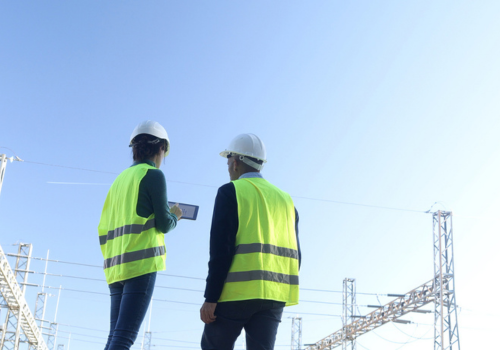
A construction crew and a control room operator are looking at the same substation. They are not looking at the same data. The crew has field notes, GPS coordinates, and equipment logs. The control room has real-time telemetry running through a Supervisory Control and Data Acquisition (SCADA) system that has no idea a new breaker went in last Tuesday. Closing that gap, cleanly and on schedule, is becoming one of the clearest differentiators between contractors utilities call back and contractors they don't.
Where the Handoff Breaks Down
Construction rework tied to poor or inaccessible project data is a well-documented problem industry-wide, with roughly 48% of all construction rework stemming from poor project data, much of it traceable to as-built documentation that was not sufficient. In addition, nearly half of rework is driven by poor collaboration and unclear documentation between teams that should have been working from the same information.
Utility construction inherits this problem and then adds a layer. The data needs to satisfy the next contractor team at the site, while also feeding into a dependable control system so that utility operators can run the grid safely. If a field crew's as-built data system doesn't match what the GIS or SCADA platform expects, someone downstream inherits a data cleanup problem.
SCADA as the Common Reference Point
As the GIS increasingly becomes the master repository of what's actually in the field, the SCADA system needs to reflect it in real time. This relationship creates the need for an automated mechanism for the SCADA control room to pull the data from the GIS to avoid pulling manually. Manually re-entering equipment definitions each time a project closes out is expensive and introduces human error, and the issues compound as the network expands.
An example of an approach aimed at eliminating data re-entry is to automate validation of GIS data before it moves into an Advanced Distribution Management System (ADMS). This approach flags errors and synchronizes data automatically rather than relying on someone downstream finding the mistakes afterward. For contractors, this shift means that a crew delivering field data in the format those systems expect, with accurate location and attribute information, closes out faster and generates fewer callbacks.
Utilities are backing this with substantial investment. The Department of Energy's Grid Resilience and Innovation Partnerships program has committed up to $10.5 billion toward grid modernization, with over $6 billion already announced across selected projects nationwide. Much of that funding supports the monitoring, automation, and control infrastructure that depends on clean field data to function as designed.
Where Telematics Fits In
Fleet telematics and SCADA are solving adjacent problems, and the contractors who connect them are ahead of the curve. Equipment location, hours, and inspection status logged automatically in the field feed the same documentation trail that utilities expect at handoff. Instead of reconstructing what happened on site from memory or paper logs, a contractor with connected fleet data can hand over a record that's already structured the way the utility's systems expect to receive it.
This doesn't require a construction crew to operate SCADA or ADMS platforms themselves. It requires understanding what those systems need: accurate location data, consistent attribute formatting, and a record that gets updated as work happens rather than reconstructed after the fact.
A Compound Advantage
Contractors who deliver structured, validated data at every handoff are building the kind of track record utilities look for when awarding multi-year framework agreements. The tools and funding driving grid modernization are already being deployed, and the contractors who treat clean data as part of the deliverable are the ones utilities trust the most.
For fresh insights into the utility industry, along with trends, challenges, and shifts shaping utility work, subscribe to the Utility Expo Newsletter.